














EB-5 Fees Set to Decrease
The proposed fee reductions are an encouraging sign for how USCIS will be allocating resources in the future.
The EB-5 Reform and Integrity Act of 2022 (RIA) included new forms and fees for Regional Centers and EB-5 investors, as well as a provision for a fee study to determine what fees would be necessary to properly fund the program. U.S. Citizenship and Immigration Services (USCIS) increased filing fees in 2024 before this study could be completed, resulting in litigation.
EB-5 stakeholders have eagerly awaited the results of the promised fee study, with concerns it could lead to increases in costs. However, a new release has provided surprisingly good news for both investors and Regional Centers.
Reduced fees for EB-5 Investors under the October 22 DHS release
On Oct. 22, 2025, the U.S. Dept. of Homeland Security (DHS) released a notice of proposed rulemaking (NPRM) that would lower application fees for immigrant investors under the EB-5 program. The notice states that after its analysis, “the projected costs of administering the EB-5 program will be lower than projected fee revenue with the current fees.” Therefore, fees will be lowered for both investors and Regional Centers, with investor fees adjusted as follows:

As Kate Kalmykov notes, “New fees would also apply to Form I-956H (Bona Fides of Persons Involved with Regional Center Program) and Form I-956K (Regional Center Investor Compliance Certification), though the changes in those categories are not as significant.”
This is assuredly good news for Regional Centers and other EB-5 professionals, who could potentially pass these savings on to investors, meaning lower costs all around for participation in EB-5.
What the reduction in fees could mean for the future of EB-5
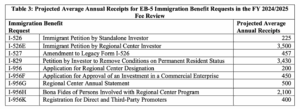
The NPRM projects that these new fees would apply to 11,262 annual filings. Because of this volume, the aggregate amounts of the fee reductions are significant. The NPRM includes projections for the costs of making these changes, and while it may appear at first that this would result in reduced revenue for EB-5, that isn’t necessarily the case. Implementing these rule changes could actually direct more money toward EB-5 by ensuring that 100% of revenue from the (now less burdensome) fees goes toward the EB-5 program.
As stated in the NPRM, “The fees are proposed to be set at a level that USCIS has determined would enable it to recover the costs of administering the EB-5 program and to allow it to attain the processing time goals.”
Providing USCIS with “the resources necessary” in order to “adequately fund the cost of administering the EB-5 program” is the key element here. Whereas EB-5 fee revenue had previously been allocated for use by other immigration programs (particularly those that don’t generate revenue), it will now be directed towards EB-5, hopefully reducing the lengthy wait times some investors face. USCIS has specific goals (outlined in the NPRM) for timely adjudication of petitions, and these fees are set at a level intended to achieve those goals.
In other words, while fees will go down, the amount of revenue that goes toward EB-5 will go up. The notice estimates that the additional revenue can result in “Added staffing to support the EB-5 program, for a total of approximately 334 employees (FTEs) across multiple USCIS offices.”
This decision to redirect revenue back toward EB-5 is practical rather than benevolent. The NPRM admits that utilizing fees for other programs “would likely result in litigation.” As Kalmykov puts it, “By proposing independent revisions rather than relying on the RIA’s framework, USCIS may be seeking to insulate itself from future challenges while maintaining operational control over the program’s financial structure.”
Perhaps the most elegant line in the NPRM is this: “DHS and USCIS appreciate the processing times expectations expressed in the EB-5 Reform Act and agree that our current backlogs are excessive.” The intent, then, is for increased staff and technological improvements (from the $95 technology fee) to get USCIS closer to meeting its own processing goals:

It’s important to note that these are goals, not mandated targets. Suzanne Lazicki explains: “DHS foresees increased resources and continuing efficiency improvements at IPO, considering RIA goals, but offers no timely processing guarantees.”
We’ll have to wait and see if these changes allow USCIS to process petitions according to its own goals. More funding, additional staffing, and improved technology could mean increased efficiency, but EB-5 stakeholders can be forgiven for remaining skeptical until results are seen.
Other notable elements of the DHS EB-5 announcement
Codifying Integrity Fund fees and penalties
The NPRM also included information on the EB-5 Integrity Fund, including fee amounts, inflation adjustments, and penalties for non-payment:
- Ten percent of the required integrity fee (e.g. 10 percent of $10,000 or $20,000 prior to adjusting such required amounts for inflation) for a regional center that pays its fees on day 31 through and including day 60 after the due date.
- Twenty percent of the required integrity fee for a regional center if their fee is paid on day 61 through and including day 90 after it is due.
- Termination of a regional center’s designation if it fails to pay the fee within 90 days of the date on which such fee is due.
The fee must be paid “between October 1 and October 31” to avoid late payment penalties. More information can be found in the NPRM under V. EB-5 Integrity Fund Fees and Penalties, which elaborates on the Regional Centers subject to a $10,000 fee (those with “20 or fewer total investors”) and those subject to a $20,000 fee.
I-829 process change
The NPRM also clarifies “the process by which an alien investor’s spouse and children file separate Form I-829 petitions when they are not included in the Form I-829 filed by the alien investor.” This applies to situations where the alien investor is deceased: rather than their derivatives (spouse and children under 21) having to file separate I-829 petitions, they can now be included under the same petition.
New form I-527 for investors associated with terminated Regional Centers
An important element of the RIA was its protections for innocent investors. As some Regional Centers face termination and investors receive 180-day notices, it’s important to recognize the NPRM also includes a new document, Form I-527, Amendment to Legacy Form I-526.
This form will be for investors who had previously invested with Regional Centers that are now terminated, so they can reinvest per the RIA’s provisions.
As the NPRM projects 457 annual receipts for Form I-527, USCIS clearly expects a considerable number of EB-5 investors to require this form each year. That means a large number of anticipated Regional Center terminations. Any operator of a Regional Center who had previously been under the impression that USCIS may be lenient when it comes to Regional Center audits and RIA compliance would be wise to rethink their strategy based on these projections.
When will the reduced EB-5 fees be implemented?
The NPRM says that “Comments are encouraged and will be accepted for 60 days from the publication date of the proposed rule.” Per WR Immigration, the proposal “will be published in the Federal Register on October 23, 2025,” meaning the period for public comments will last until December 22, 2025. After comments are considered, “DHS will complete and publish a final fee study that will take effect 60 days after publication.”
This gives ample time for EB-5 stakeholders to review the NPRM and make comments, but also means any actual change in fees will not occur for some time. Those already concerned about the 2026 grandfathering deadline likely will not want to wait for the reduced fees to take effect, and EB-5 projects will continue at the same pace.
Stay up-to-date on the latest EB-5 news
As with many things related to USCIS and EB-5, we may end up waiting longer than we expect for the promised final fee study. But as this notice shows, positive developments can happen unexpectedly. As a leader in EB-5 administration, JTC sees it as part of our mission to stay on top of all new developments and inform our clients, colleagues, and other readers of important EB-5 news, industry trends, and issues that arise.
To keep up with the most recent EB-5 news and insights, sign up for our monthly EB-5 newsletter, where you’ll receive news items, opinion pieces, analysis, events, interviews, and more concerning the EB-5 program and its future.
Stay Connected
Stay up to date with expert insights, latest updates and exclusive content.
Discover more
Stay informed with JTC’s latest news, reports, thought leadership, and industry insights.

Let’s Bring Your Vision to Life
From 2,300 employee owners to 14,000+ clients, our journey is marked by stability and success.