













Who Owns the Story? Transmitting-Family-Business Legacy Across Generations
Family business legacy at a glance
- History and legacy are not the same thing: history records what happened, legacy explains why it still matters to those who come after
- Family stories only become legacy when younger generations understand them well enough to answer who they are and what they’re responsible for
- A founder’s story can become a burden if it’s seen as something to imitate rather than a set of principles to reinterpret
- Passing on legacy works best when Next Gen education is paired with hands-on experience, such as taking part in governance, philanthropic activities and family discussions
- The next generation moves from being recipients of a legacy to becoming its authors, shaping its futures for generations to come
Who Owns the Story? How Families Transmit Legacy Across Generations
Family businesses are full of stories. There is the story of the founder who started with almost nothing. The crisis the family somehow survived. The product that changed everything. The customer who trusted the company when nobody else did. The sacrifice that made growth possible. These stories are told and retold, at family dinners, at company anniversaries, in the corridor before a shareholder meeting. Over time, they stop being anecdotes and become something closer to the family’s understanding of itself.
But there is an important difference: having a history is not the same as passing on a legacy. History records what happened. Legacy explains why it still matters.
This distinction becomes decisive the moment a family moves from one generation to the next. The question is no longer simply whether younger members know the family story, and most of them do. The deeper question is whether they see themselves inside that story, and whether they feel entitled to write its next chapter.
Legacy does not survive because the next generation remembers the past. It survives because each generation makes the past meaningful for the future.
– Professor Andrea Calabrò, SDA Bocconi School of Management, Milan, Italy
From History To Legacy
Research on family business identity has increasingly pointed to the role of narrative in helping families construct continuity across generations. Stories, in this sense, do more than simply remember the past. They help family members answer who they are, what the family stands for, and what is expected of them as owners.
In our work on the Family Legacy Monitor, we find it useful to distinguish between these two functions: preserving the memory of the past and transmitting its meaning to future generations. Families often treat them as the same thing, but they are not, and when the distinction is overlooked, legacy can easily lose clarity and direction.
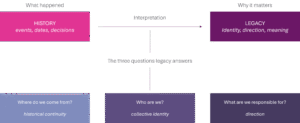
Fig. 1 — How family history becomes legacy
Together, these three questions do something history alone cannot do: they transform a set of stories into an ownership identity. And that transformation matters more, not less, as families grow. First-generation siblings become second cousins, then third cousins, then branches of an ownership family that may never share a dinner table. Members live in different countries, hold different passports, pursue different careers, and relate to the operating business in very different ways. At that point, biology is rarely sufficient to hold a family together. A shared ownership identity has to do work that proximity and blood once did. Recent research on owner-family identity and governance points in the same direction: as families scale, meaning increasingly substitutes for closeness.
Every Family Has A Founding Story
Most family enterprises carry an origin story, and it very often revolves around a single figure: an entrepreneur who spotted an opportunity, took a risk nobody else was willing to take, or built something that simply did not exist before. Founding stories matter because they simplify complexity. A business grows through thousands of decisions, relationships and sometimes coincidences, yet families construct a narrative that explains, retrospectively, what really mattered. The message crystallises into something portable: we have always been entrepreneurs; we never compromise on quality; we take care of our people; we reinvest rather than consume; we survive because we adapt. These statements do not describe everything that happened exactly. They are interpretations of the past and that is exactly why they matter. Business families use stories to select which parts of their history should guide the future. The selection is the act of leadership; the story is simply where it becomes visible.
The Risk Of The Heroic Founder
There is, however, an important paradox, and it is worth stating clearly because it can become a major obstacle for many families. The stronger the founder’s story becomes, the harder it can be for the generations that follow to find their own place inside it. A founder remembered as courageous, visionary or entrepreneurial can unintentionally set an impossible standard of comparison for descendants. The next generation may never say it aloud, but the question sits there regardless: how could I ever compete with that?
This is precisely why legacy should never collapse into the celebration of an individual. When legacy becomes synonymous with the founder, continuity depends on imitation and this is a strategy that becomes weaker with every generation. When legacy is translated into principles continuity instead allows for reinvention.
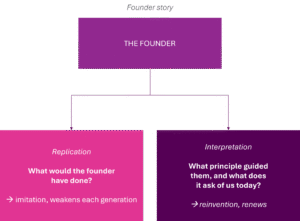
Fig. 2 — Two ways to read the founder’s story
The useful question, in other words, changes shape. It stops being “what would the founder have done?” and becomes “what principle guided the founder, and what would that principle require from us today?”. The difference is subtle on the page and fundamental in practice. The first question seeks replication. The second seeks interpretation, and interpretation is the only mode of continuity available to a business family that intends to still exist in fifty years.
From Education To Experience
Next generation education is one of the most effective ways to begin the process of legacy transmission. Through dedicated programs, younger family members can develop a deeper understanding of ownership, governance, finance, entrepreneurship, and the history of the family enterprise. Education creates the foundations: it gives the next generation the language, knowledge, and context needed to understand what family ownership means and why it matters.
The next step is to connect this learning with experience. Legacy becomes stronger when knowledge is reinforced through participation as for example, by joining family discussions, visiting the business, meeting employees, contributing to projects, or taking part in governance (e.g., family meetings and/or councils) and philanthropic initiatives. In this way, education does not simply transfer information. It prepares the next generation to engage with the family legacy, interpret it, and eventually contribute to its evolution.
This means creating real opportunities for younger generations to experience the family firm rather than simply hear about it. Through this kind of exposure, abstract values stop being abstract. Responsibility becomes a decision someone actually has to make. Entrepreneurship becomes an initiative someone actually has to defend. Stewardship becomes a behavior someone actually has to practice, with a certain pressure, in front of people who are watching.
The Next Generation Must Be Allowed To Interpret
Successful transmission also requires accepting something that many senior generations find often difficult: the next generation will understand the family’s legacy differently, and this is not necessarily a failure. It may be evidence that the legacy is still alive.
Each generation inherits different technologies, different markets, different social expectations, and a different definition of success. Expecting identical interpretations across generations is not realistic, and insisting on it usually produces the opposite of cohesion.
The objective is not perfect alignment on every issue. It is sufficient alignment on a small number of enduring principles.
Perhaps independence matters. Perhaps entrepreneurship matters. Perhaps the family name must remain synonymous with integrity. Perhaps wealth must create opportunities beyond the family itself. Those principles can stay stable even as their expression changes completely. A family committed to entrepreneurship once demonstrated that commitment by opening factories. A later generation may express the very same legacy by backing technology ventures or launching an impact-investment platform. The activity changes. The underlying meaning does not.
The Family Archive Is Not The Legacy
Families often preserve unique historical material: photographs, letters, jewellery, company documents, products, buildings, entire archives. These assets are valuable. They provide evidence of where the family came from, and they can strengthen identification with its history.
But an archive preserves memory. It does not, on its own, create legacy. The crucial step is interpretation: why is this story still relevant; what does this decision teach us; what principle should future owners take from it; and, just as importantly, what should we no longer carry forward? A mature business family is able not only to celebrate its history but to question it. Some behaviours that contributed to success in one generation are simply inappropriate in another. Legacy, in this sense, requires selection. Not everything inherited deserves to be preserved.
Creating Spaces for Intergenerational Conversation
One of the most practical ways to strengthen legacy transmission is also the simplest: structured conversation between generations, held deliberately outside the usual review of business performance.
For the senior generation
- Which decisions are you most proud of?
- Which would you make differently today?
- What nearly destroyed the business?
- What should never become unquestionable?
For the next generation
- Which parts of the family story inspire you?
- Which parts feel distant?
- What does responsible ownership mean to you?
- What would make you proud to stay connected?
The purpose of asking these questions side by side is not to produce identical answers. It is to surface different interpretations before those differences turn into conflict. The business families who do this well treat the conversation as a governance instrument, not a family-therapy exercise and schedule it with the same seriousness as a board meeting.
From Heirs To Authors
Perhaps the most consequential shift occurs when younger family members stop seeing themselves as recipients of a legacy and begin seeing themselves as its authors. An heir receives something created by someone else. An owner participates in deciding what happens next.
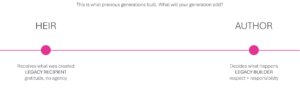
Fig. 3 — From legacy recipient to legacy builder
Families that continuously remind younger members of everything previous generations built can unintentionally create gratitude without agency which can result in a next-generation member who is dutiful, informed, yet quietly disengaged. The stronger objective is to combine respect for the past with responsibility for the future. The message becomes: this is what previous generations created; what will your generation add? That single reframing does most of the work. It turns the next generation from custodians of memory (legacy recipient) into creators of continuity (legacy builder):
Legacy Is A Conversation Across Time
Family business legacy is often pictured as something moving in one direction, from older generations toward younger ones. In practice, enduring legacy is more reciprocal than that. Older generations provide history, experience and meaning. Younger generations reinterpret that meaning inside a different world, with different tools and different pressures. And through that ongoing dialogue, the family’s legacy evolves rather than simply persists.
The strongest business families do not simply tell the next generation their story. They invite them into it. A legacy does not survive because descendants can repeat the story of the past. It survives when they understand its meaning well enough to write the next one.
Your Family’s Story is Still Being Written
Legacy isn’t inherited automatically, it’s shaped by the conversations, governance and decisions each generation makes. JTC’s Private Office team works with family principals and next-generation members to turn that intention into structure.
Stay Connected
Stay up to date with expert insights, latest updates and exclusive content.
Discover more
Stay informed with JTC’s latest news, reports, thought leadership, and industry insights.




Let’s Bring Your Vision to Life
From 2,500 employee owners to 14,000+ clients, our journey is marked by stability and success.